Cold Reading for Actors: How to Stay Present When You Don’t Know the Lines
Cold reading makes a lot of actors nervous.
You don’t know the material well, you’re trying to keep up, and at the same time you feel like you have to “perform.”
That combination usually leads to one thing.
You get in your head.
I see it all the time in class. The second an actor starts worrying about the words, they stop listening.
And once that happens, the work starts to fall apart.
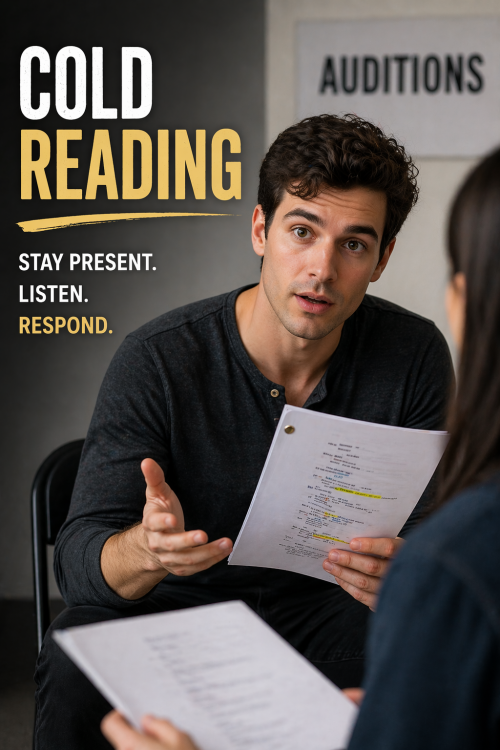
Let’s get clear about what cold reading actually is, and how to approach it so you stay present instead of tightening up.
1. You’re Trying to Read It Perfectly
This is the first mistake.
Actors think cold reading is about not messing up. So all their attention goes to the words, saying them correctly, keeping it smooth.
But the more you focus on getting it right, the less connected you are.
In my class, I’ll stop actors right there. Because the issue isn’t the reading, it’s where your attention is.
What to change:
- Stop trying to read it perfectly
- Let it be a little messy if it needs to be
- Keep your attention on the other person
Cold reading isn’t about clean delivery. It’s about staying engaged.
2. You Stop Listening Because You’re Thinking Ahead
When you don’t know the lines, your instinct is to get ahead of the script.
You start scanning, looking for your next line, trying to stay on top of it.
But the second you do that, you’re not listening anymore.
And if you’re not listening, there’s nothing to respond to.
This is something I point out constantly in my acting classes online. Actors think they’re working, but they’re actually just trying to keep up.
What to change:
- Stay with what’s being said right now
- Don’t jump ahead in your head
- Let each moment land before moving on
If you stay with the other person, the work will take care of itself more than you think.
3. You Treat It Like a Reading Instead of a Scene
This is subtle, but it changes everything.
Actors lower their level of commitment because it’s a cold read.
They think, “It’s just a reading.”
So the work becomes lighter, less specific, less engaged.
But your job hasn’t changed.
In my class, I treat cold reads the same way I treat scene work. You’re still in a relationship. You’re still trying to get something from the other person.
What to change:
- Treat it like a real scene
- Stay connected to the relationship
- Let yourself respond fully, even with the script in your hand
The script doesn’t change the work. Your approach does.
4. You Freeze When You Lose Your Place
This happens to everyone.
You lose your spot, you stumble, something doesn’t come out right.
And then you panic.
I’ll see actors completely drop out of the moment because of one small mistake.
What to change:
- Keep going, don’t stop the moment
- Stay connected even if the words aren’t perfect
- Let the mistake be part of it instead of fighting it
What matters is that you stay in it. That’s what casting responds to.
5. You Try to Control the Outcome
This is the bigger issue underneath everything.
You want it to go well. You want to look good.
So you start managing it.
That’s when everything tightens up.
One of the best pieces of audition advice I got years ago was to treat each audition as a job, as if you already have the job.
This kills two birds with one stone. It boosts your confidence, and it reduces audition anxiety.
Because if you already “have it,” there’s nothing to prove.
In class, this is where I’ll push actors to take more risk, not less. Because playing it safe is what kills the work.
What to change:
- Let go of trying to be good
- Walk in like the job is already yours
- Take chances, even if they don’t land perfectly
- Focus on responding, not presenting
If you can stay present here, you can stay present in anything.
6. You Don’t Trust Simple Work
Actors think they need to do more to make a cold read “interesting.”
So they push, add, try to create something.
That’s usually when it starts to feel forced.
In my class, we’re constantly pulling things back to something simpler and more direct.
What to change:
- Keep it simple
- Let the situation do the work
- Trust that listening is enough
Simple, connected work will always land more than something pushed.
What Good Cold Reading Actually Feels Like
When it’s working, it doesn’t feel controlled.
It feels like:
- You’re staying with the other person
- You’re not panicking about the lines
- You’re letting moments happen, even if they’re imperfect
- You’re responding instead of trying to keep up
That’s when it starts to feel like real work.
FAQ: Cold Reading for Actors
What is cold reading in acting?
Cold reading is performing a scene with little or no preparation, usually while holding the script.
How can I get better at cold reading?
Focus on listening and staying present instead of trying to read perfectly. That’s where the work actually happens.
Is it okay to make mistakes during a cold read?
Yes. In most cases, no one cares about the mistake if you stay connected.
Should I memorize lines for a cold read?
No. The goal is to work truthfully with the script in hand.
What are casting directors looking for?
They’re looking at how you respond under pressure, not whether you read it perfectly.
Want to Get More Comfortable with Cold Reading?
Cold reading gets easier when your process is solid.
If you’re focused on listening and responding, instead of controlling the outcome, you won’t fall apart when the pressure is on.
That’s the kind of work we focus on in my acting classes online.
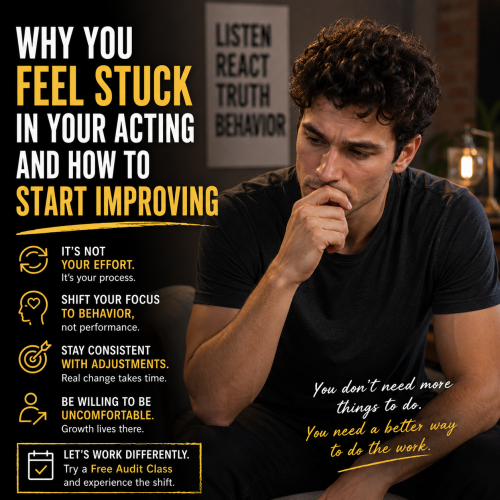
You can also start with a Free Audit Class and experience how this works in real time.
When your foundation is strong, cold reading stops being something you survive, and starts being another opportunity to work.