Memorizing Lines: Getting Off the Page (Part 1 of a 4-Part Series, Getting Off the Words)
By Richard Kline
Actors often think memorizing is about locking the words in like a safe. Like if you just repeat the lines enough times, you’ll have them forever.
And yes, repetition matters. But the reason actors go up on lines usually isn’t because they’re “bad at memorizing.” It’s because they’re memorizing the wrong thing.
If you memorize words without owning the thought underneath them, you’re going to feel stuck to the page. You’ll sound careful. You’ll sound like you’re reciting. And under pressure, that kind of memory gets shaky fast.
Here’s the core idea:
Memorize the meaning first. The words ride on the meaning.
This is Part 1 of a 4-part series on memorizing lines in a way that gets you off the page and into real acting. We’re starting with the foundation: getting off the words.
What “Getting Off the Page” Actually Means
Getting off the page doesn’t mean you stop caring about the text. It means you stop clinging to it.
When actors cling to the words, they’re usually trying to protect themselves from forgetting. But that protection creates the exact problem you’re trying to avoid, because it pulls you out of the moment.
In the studio, I want you connected to something much more dependable than word recall. I want you connected to thought, intention, and forward momentum. That’s what holds the lines in place.
The 4-Step Process That Works Every Time
If you’re working on a monologue or dialogue, start here. This is simple, and it immediately changes your relationship to the material.
- Read the monologue.
- Close the script.
- Say it in your own words.
- Go back to the exact text.
That third step is the one actors skip, and it’s the one that makes everything easier. Because if you can’t paraphrase what you’re saying, you don’t actually understand what you’re doing.
When you understand the thought, the line becomes easier to retain. You’re not memorizing a paragraph. You’re attaching language to something you already own.
Try this:
Memorize the meaning first. Then return to the text. The words ride on the meaning.
Don’t Memorize by Sentences, Memorize by Beats
This is one of the biggest shifts you can make.
Actors memorize by sentences because that’s how the script is printed. But acting isn’t printed. Acting is action. It’s changes. It’s shifts. It’s you trying to get something from somebody.
So instead of memorizing by sentence, memorize by beats.
A beat is a section where the intention stays the same. When the intention shifts, you’re in a new beat. Those shifts give you shifts in tone, and they give you a structure your brain can actually hold onto.
- Mark the shifts in intention.
- Notice how each shift changes the tone.
- Separate the monologue into beats.
When you work in beats, you stop feeling like you have to remember “the whole thing” all at once. You’re just moving through a series of actions. That creates momentum, and momentum supports memory.
Title Each Beat and Give It a Verb
Once you have your beats, name them. Keep it simple. One short title that tells you what the beat is about.
Then assign a verb. Not a feeling, a verb. Something playable.
Here are a few that show up constantly in scenes:
- to accuse
- to seduce
- to defend
- to confess
- to forgive
- to challenge
- to reassure
- to dismiss
Here’s why this matters. Once the intention is clear, memory locks in because intention creates forward momentum. You’re not hunting for lines. You’re doing something. And when you’re doing something, the words have a reason to appear.
The Grunt Work That Builds Real Memory: Write It by Hand
Now we get to the unglamorous part. But it works.
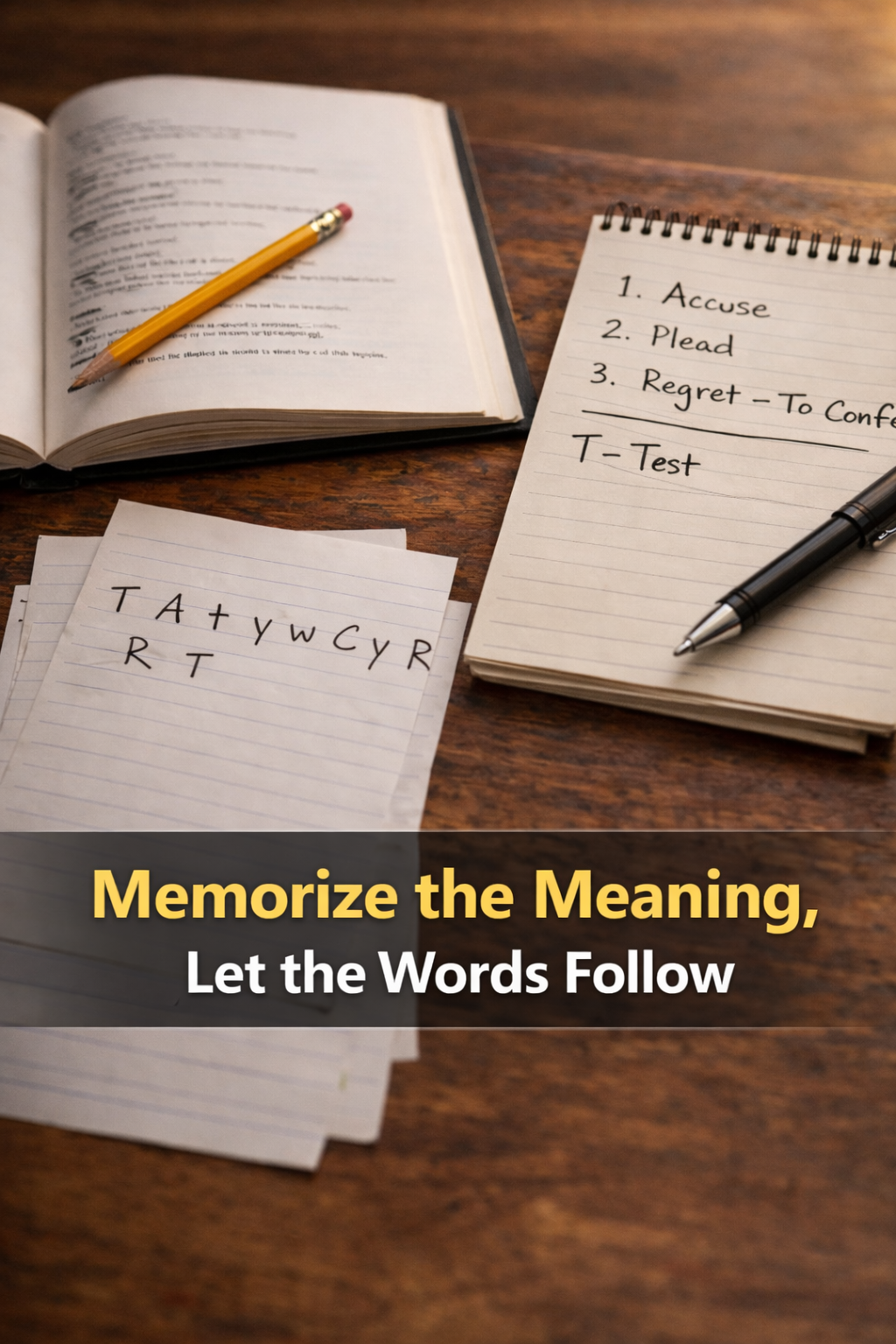
If you want to build dependable recall, do this handwriting drill:
- Write the monologue out in longhand.
- Then write only the first letter of each word.
- Speak it using the letter sheet.
What you’re doing here is building muscle memory and pattern recognition. And when you speak off the letter sheet, you’re training retrieval. That’s the skill that holds up in auditions, on set, and under pressure.
Important:
Reading is not memorizing. Retrieval is memorizing. The letter sheet forces retrieval without letting you rely on the page.
A Simple Practice Plan for the Week
If you want a clean way to apply Part 1 right now, do this:
- Day 1: Read it, close it, paraphrase it, then return to the text.
- Day 2: Mark beats, title beats, assign verbs.
- Day 3: Handwrite the monologue, then create the first-letter sheet.
- Day 4: Speak from the letter sheet, then run it focusing on verbs.
- Day 5: Run it for someone, and track where the thought drops. Fix the thought first.
That last line matters. When you drop a line, don’t panic and repeat it ten more times. Find the thought you lost. If the thought is clear, the words come back.
What’s Coming in Part 2
In Part 2, we’re going to talk about how memorization gets easier when you stop doing it alone. Listening, cue pickup, and relationship are some of the most powerful memory tools you have, because the other person becomes your trigger.
Want to work on this with real guidance?
In my online acting classes, we train actors to memorize faster by working from intention, beats, and real listening so the work stays alive. Join the workshop here: Richard Kline Online Acting Workshop
You can also start with a Free Audit Class and experience how we work in the online studio.
FAQ: Memorizing Lines and Monologues
How do I memorize lines faster?
Memorize the meaning first, then return to the exact text. Break the piece into beats and assign verbs so the lines have structure and forward momentum.
What are beats in acting?
Beats are sections where the intention stays the same. When your intention changes, you’re in a new beat. Beats help you stay alive and make memorization easier.
Why do I sound robotic when I’m memorized?
Because you memorized words without owning the thought. When you work from intention and playable actions, the delivery becomes more spontaneous and connected.
Does writing lines by hand really help?
Yes. It builds muscle memory and pattern recognition. The first-letter sheet adds retrieval practice, which strengthens recall under pressure.
Where can I train this approach?
We work on this directly in the Richard Kline Online Acting Workshop, with real-time feedback and exercises that translate to auditions.