

Why Great Actors Never Stop Listening
Most actors think listening means waiting quietly for their next line. Great actors know that real listening changes everything, and it is one of the biggest reasons their performances feel alive.

In-depth acting articles and insights on technique, auditions, and the business of acting. Written by a working actor and respected acting teacher, drawing from decades of studio training and professional experience.

Most actors think listening means waiting quietly for their next line. Great actors know that real listening changes everything, and it is one of the biggest reasons their performances feel alive.

Some actors capture your attention without doing very much at all. Learn why truly watchable performances come from connection, not performance, and how you can bring that same quality into your own work.

If your work feels general, it is not personal enough. The personal monologue teaches you how to bring your real life, your truth, and your emotional connection into every role you play.
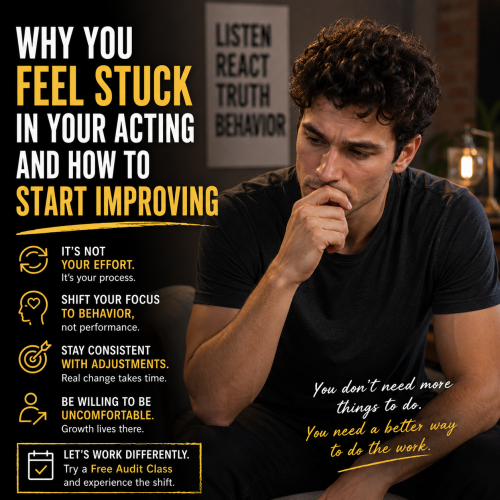
If you feel stuck in your acting, it is not because you are not working hard enough. Learn what is actually holding you back and how to shift your process so your work starts to change.
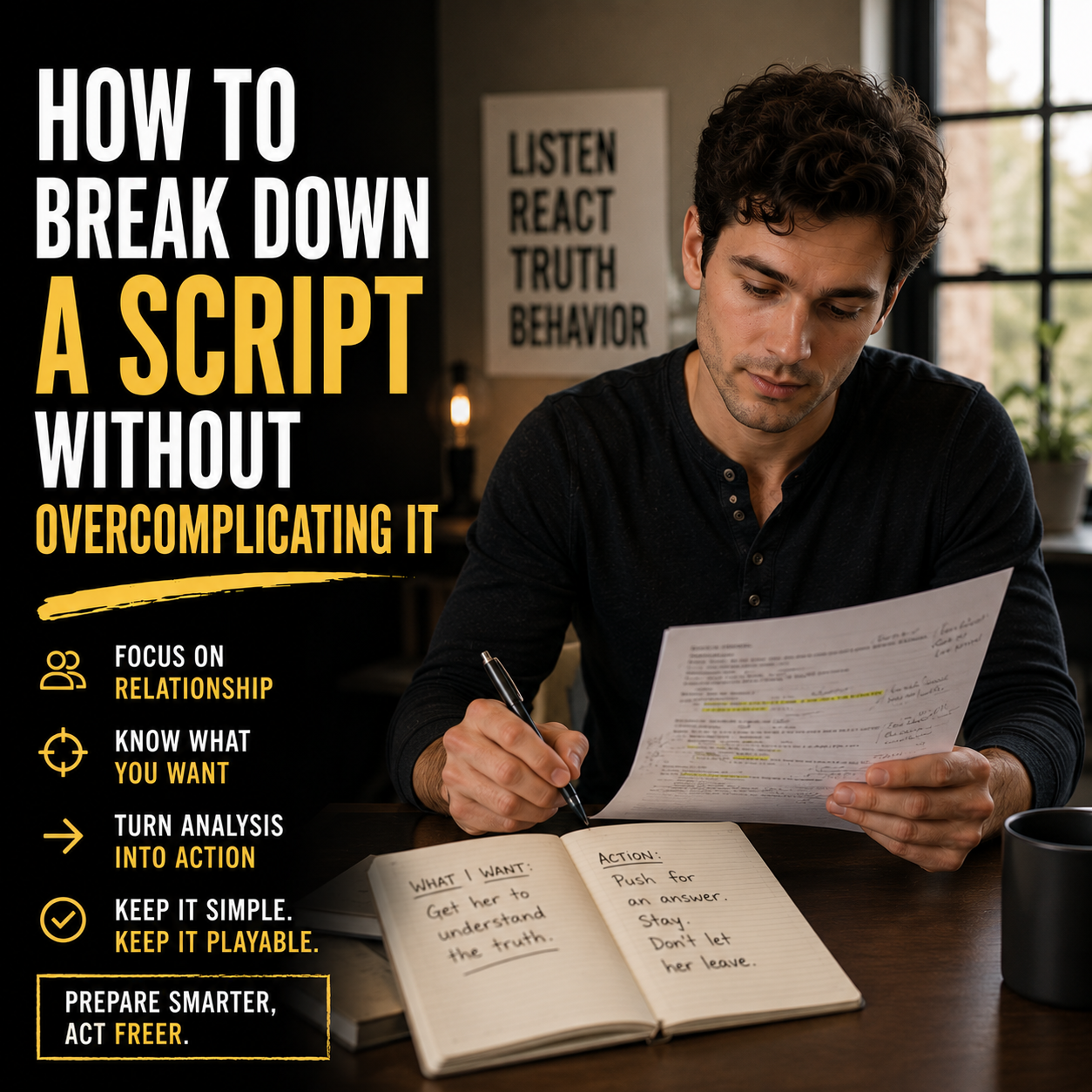
Most actors turn script analysis into something heavy and confusing that does not actually help their performance. Learn how to break down a script in a simple, usable way that keeps you connected and responsive.



No fluff, just solid advice about acting and your career.
You need to be personal in your work. Not “emotional” in a general sense, not “interesting,” not “watchable.” Personal. Specific. Connected to something real inside you.
That is where the personal monologue comes in. It is one of the most powerful tools you can use in your actor training because it strips away performance habits and forces you to work from your own life.
And when you do that honestly, everything changes.
A personal monologue is exactly what it sounds like. You write or improvise a piece based on something from your own life, something you feel strongly about.
This is not about writing a perfect scene. It does not have to be theatrical. It does not have to be clever. It just has to be honest.
It could be:
I have seen actors write about all of these. And when they commit to it, really commit, the work becomes alive in a way that technique alone cannot create.
Most actors avoid being personal. Not consciously, but instinctively.
They generalize emotions. They indicate feelings. They perform the idea of a moment instead of living inside it.
Why? Because being specific is risky.
It means:
But here is the truth. If it is not personal to you, it will not be compelling to an audience.
The camera sees through general work immediately. Casting can feel when something is disconnected. The personal monologue trains you out of that habit.
When you do a personal monologue, your job is not to “act it well.” Your job is to experience it truthfully.
You are not presenting something. You are going through something.
This is where real listening and reacting begins. The same principles we focus on in my acting classes online apply here:
If you are controlling it, shaping it, or trying to make it “good,” you are already moving away from the work.
The personal monologue demands vulnerability. There is no way around it.
You are dealing with your life, your feelings, your emotional history. That can feel uncomfortable at first. It should.
But this is not about exposure for its own sake. It is about developing access.
When you allow yourself to go there, you begin to:
This is what creates depth. Not technique alone, but technique supported by real, personal connection.
Here is where many actors go off track. They confuse “personal” with “complaining.”
The personal monologue is not about listing everything that went wrong in your life. It needs to be about something.
You are working something out.
Ask yourself:
That gives the monologue direction. It gives it behavior. It gives it life.
And just as important, get specific. General stories create general acting. Specific moments create real behavior.
You can approach this in a simple, practical way:
This is the same kind of process we apply to scene study and audition technique. The difference is that here, the material is coming directly from you.
This is where the personal monologue becomes incredibly valuable.
Once you experience what it feels like to be fully connected, you can start bringing that same immediacy into scripted material.
Whether you are working on Shakespeare, a film scene, or a short TV audition, the goal is the same:
Every role should feel as if you wrote it. Not literally, but emotionally. As if the thoughts are yours.
That is what separates actors who are watchable from actors who are compelling.
From Hamlet to a one-line role on a TV spot, your job is the same. Bring yourself to it.
Not a version of yourself that you think casting wants. Not a polished performance. You.
The personal monologue proves that you can do that. It shows that you can be:
And once you have that, you can apply it anywhere.
This is a core part of the work we do in my acting classes online, training actors to stop presenting and start experiencing.
The personal monologue is not just an exercise. It is a process.
If you do it honestly, it will affect you, not just as an actor, but as a person. You will discover things. You will shift how you approach your work.
And most importantly, you will stop acting “in general” and start working from something real.
If you want to go deeper into this kind of work, you can explore it in a practical, supportive environment through a Free Audit Class and see how this approach applies directly to auditions, scene study, and professional acting technique.
What is a personal monologue in acting?
A personal monologue is a piece created from your own life experiences, focused on something emotionally meaningful and specific to you.
Do I need to write it ahead of time?
You can write it or improvise it. The key is staying connected to the experience, not the exact words.
How does this help with auditions?
It builds emotional access and authenticity, which translates directly into stronger, more believable audition work.
What if I feel uncomfortable being that personal?
That is part of the process. Start where you can, but understand that growth comes from gradually allowing more honesty into your work.
Can I use this approach for scripted roles?
Yes. The goal is to bring the same personal connection and immediacy into any script you are working on.
