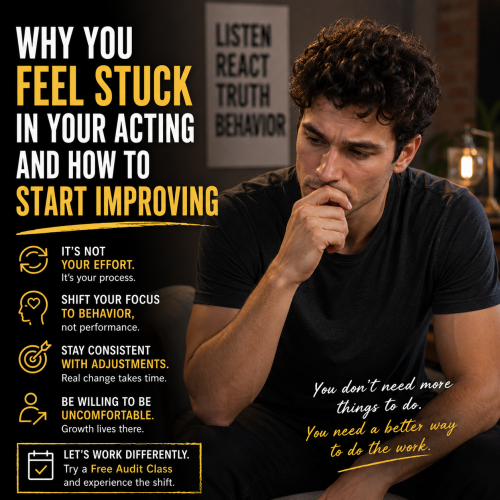

Why You Feel Stuck in Your Acting and How to Start Improving
If you feel stuck in your acting, it is not because you are not working hard enough. Learn what is actually holding you back and how to shift your process so your work starts to change.
In-depth acting articles and insights on technique, auditions, and the business of acting. Written by a working actor and respected acting teacher, drawing from decades of studio training and professional experience.

If you feel stuck in your acting, it is not because you are not working hard enough. Learn what is actually holding you back and how to shift your process so your work starts to change.

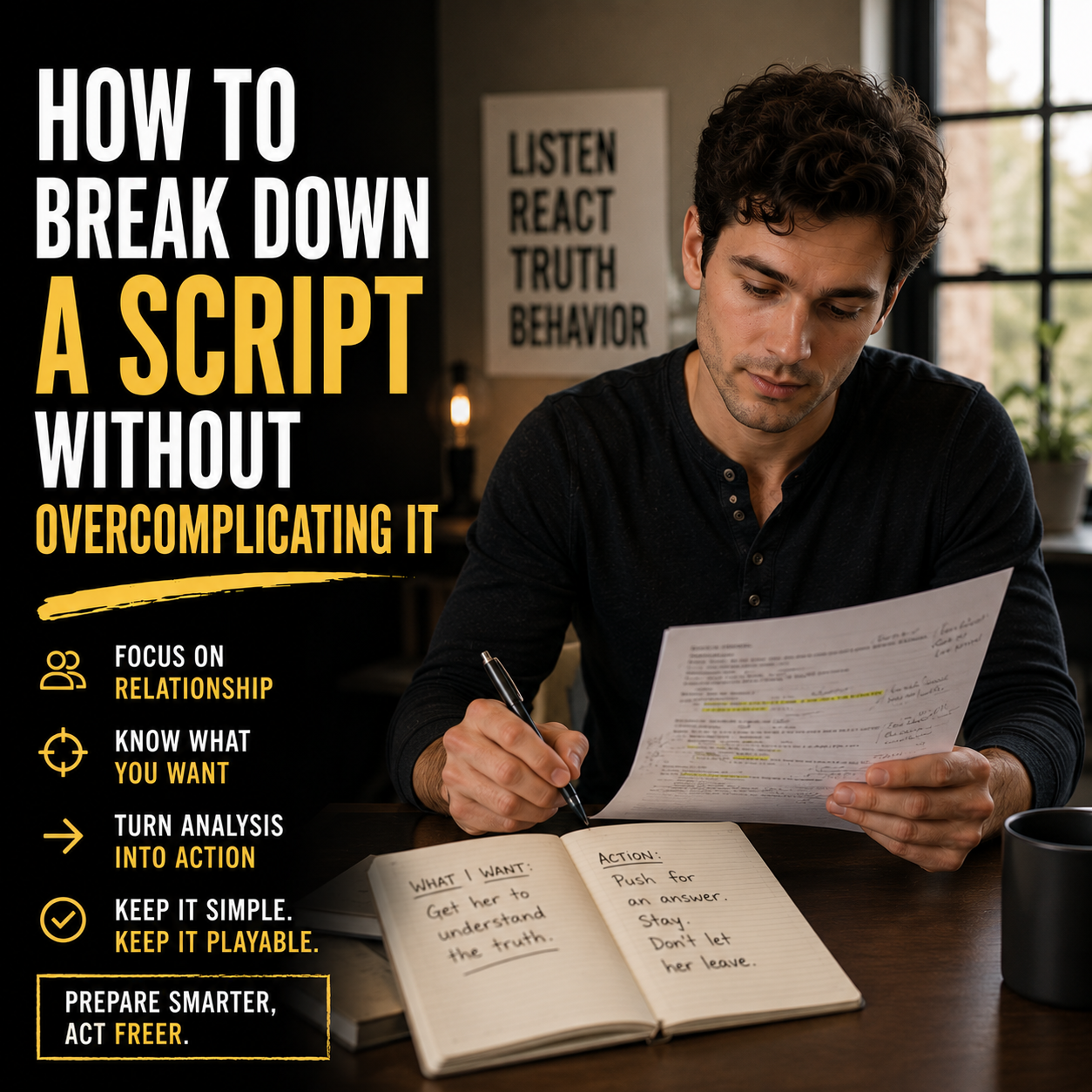
Most actors turn script analysis into something heavy and confusing that does not actually help their performance. Learn how to break down a script in a simple, usable way that keeps you connected and responsive.
If your self tape feels flat, it is not a camera problem, it is a connection problem. Learn how to bring your work to life by focusing on behavior instead of performance.

Most actors over prepare in their head and lose what actually makes a performance feel real. Learn how to prepare for auditions in a way that keeps you present, responsive, and alive in the moment.

Not all acting classes actually change your work, even if they feel productive. Here’s how to tell if your training is moving you forward or just keeping you busy.


No fluff, just solid advice about acting and your career.
“I’m stuck.” I hear this, or a variation, a lot in my teaching.
They get stuck because they’re doing the same kind of work over and over again, and it’s not actually changing anything.
“How can I make interesting choices?” I hear that a lot too.
If you’ve been in class, doing scenes, showing up, putting in the time, but your auditions still feel the same, your instincts haven’t deepened, or you’re relying on the same choices, something in your training needs to shift.
Let’s get specific about where actors get stuck, and what actually moves you forward.
This is the most common issue I see.
Actors come into class with a plan. They’ve decided how the scene should feel, how the character should come across, what the “moment” is supposed to be. Or they try to second-guess casting as to “what they’re looking for.”
Then they try to execute it.
That’s not acting. That’s presenting an idea.
If you’re training like that, you’ll feel stuck because nothing real is changing underneath. Nothing is organic.
What to change:
Real growth happens when your attention shifts off yourself and onto the relationship. The person you’re sharing the scene with.
DANGER: If you’re constantly analyzing your performance while you’re doing it, nothing will take you out of the scene more than that.
That is what kills spontaneity.
You might feel productive because you’re “working,” but internally you’re managing, adjusting, and judging.
What to change:
If you keep getting the same notes, or worse, no real notes at all, it’s very hard to change.
Some classes stay on the surface. You do a scene, you get general feedback, and you move on.
You might feel good after class, but nothing is being disrupted.
And without disruption, there’s no growth.
What to change:
In my acting classes online, you should feel like something specific is being worked on, not just presented.
This is subtle, but important.
Many actors treat class like a place to show their best work.
I don’t conduct my class as a “performance venue.” I treat it like an intensive rehearsal.
What to change:
The actors who improve the fastest are not the ones who look the best. They’re the ones willing to work openly.
This is where a lot of frustration shows up.
You’re in class every week, but when it’s time to do a self tape or a cold read, you fall back into old habits.
That usually means your training is staying inside the classroom instead of becoming instinct.
What to change:
When your training is solid, your audition technique becomes an extension of it, not a separate skill.
Actors often feel stuck because they’re looking for a quick shift.
But real change in acting is internal. It builds over time.
It shows up first in small ways. You feel more present. You respond more honestly. You stop forcing moments.
Then it starts to show up in your work.
What to change:
Consistency in my acting classes online is what builds real instinct.
When your training starts working, it doesn’t feel like control.
It feels like:
That’s when you know something real is happening.
Why do I feel stuck even though I’m taking acting classes?
Because repetition alone isn’t enough. If the work isn’t targeting your habits or shifting your focus toward listening and behavior, you’ll stay in the same patterns.
How long does it take to improve as an actor?
It depends on the quality and consistency of your training. It depends also on how committed you are to class. I am thrilled when I see students take their work to the next level.
Should I switch acting classes if I feel stuck?
Not always, but you should evaluate whether your current class is challenging your habits and giving you specific, actionable adjustments.
Why don’t my acting classes help my auditions?
If your class focuses on performance instead of behavior, it won’t translate. Auditions require the same listening and reacting skills as strong scene study work.
Is it normal to feel worse before getting better?
Yes. When you start letting go of control and working more truthfully, it can feel unfamiliar and uncomfortable at first. That’s often a sign of progress.
If you recognize yourself in any of this, it’s time to evaluate how you approach the work.
Focus on training that builds real listening, real behavior, and real connection.
If you want to experience that for yourself, you can join my class or start with a Free Audit Class and see how the work feels in real time.
Explore the training here: https://richardkline.tv/programs/workshop/
That shift, from controlling your work to actually experiencing it, is what gets you moving again.