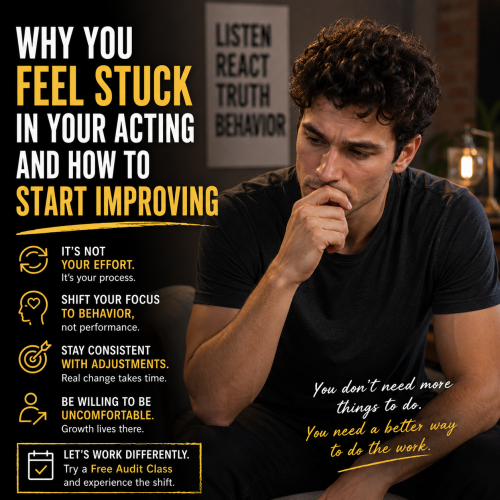

Why You Feel Stuck in Your Acting and How to Start Improving
If you feel stuck in your acting, it is not because you are not working hard enough. Learn what is actually holding you back and how to shift your process so your work starts to change.
In-depth acting articles and insights on technique, auditions, and the business of acting. Written by a working actor and respected acting teacher, drawing from decades of studio training and professional experience.

If you feel stuck in your acting, it is not because you are not working hard enough. Learn what is actually holding you back and how to shift your process so your work starts to change.

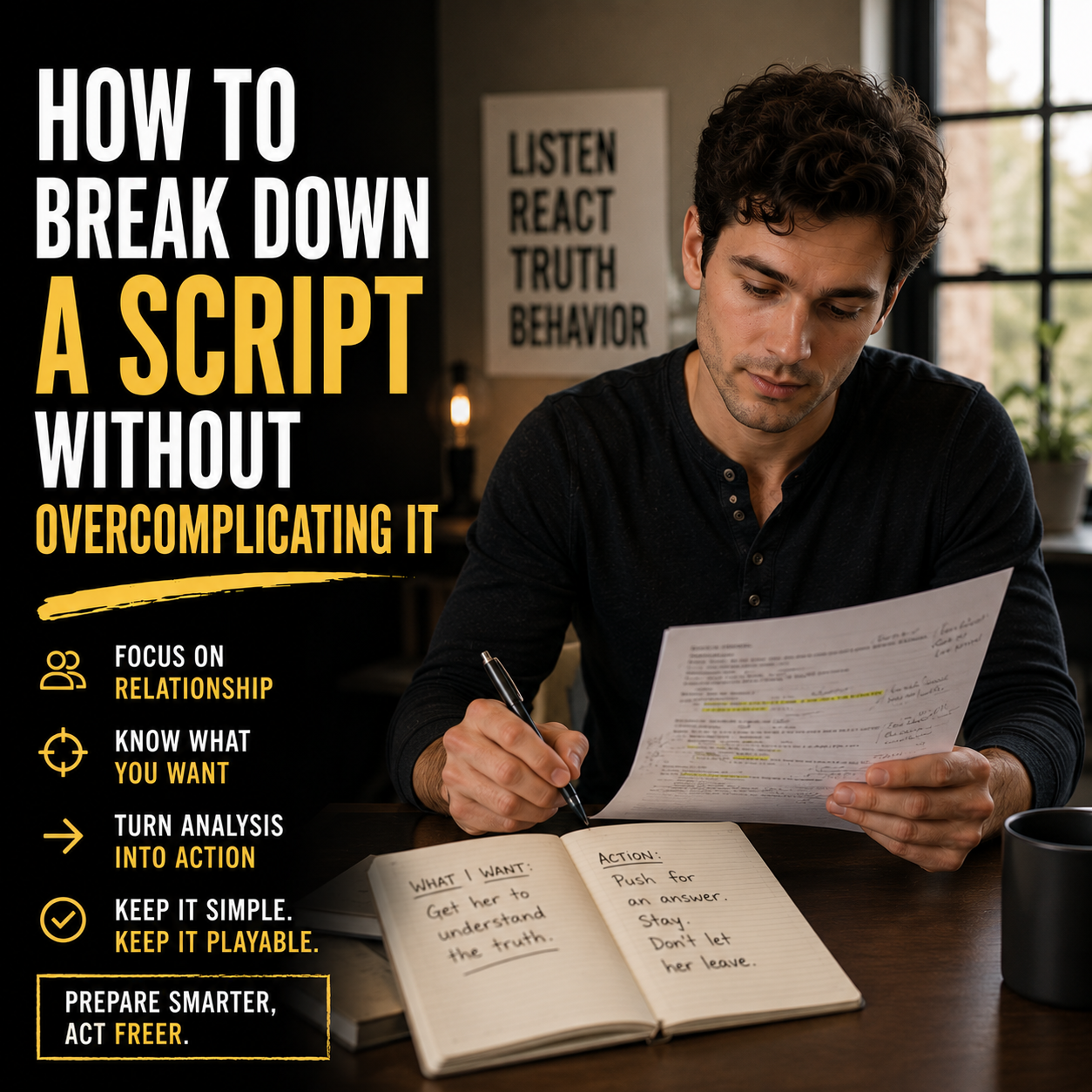
Most actors turn script analysis into something heavy and confusing that does not actually help their performance. Learn how to break down a script in a simple, usable way that keeps you connected and responsive.

If your self tape feels flat, it is not a camera problem, it is a connection problem. Learn how to bring your work to life by focusing on behavior instead of performance.

Most actors over prepare in their head and lose what actually makes a performance feel real. Learn how to prepare for auditions in a way that keeps you present, responsive, and alive in the moment.

Not all acting classes actually change your work, even if they feel productive. Here’s how to tell if your training is moving you forward or just keeping you busy.


No fluff, just solid advice about acting and your career.
By Richard Kline
This is Part 2 of a 4-part series on memorizing lines in a way that gets you off the page and into real acting. In Part 1 we talked about meaning first, beats, verbs, and why memorizing by sentences makes actors stiff. Now we take the next step, and it is the step most actors skip.
Stop trying to memorize alone.
Actors think memorization is a private battle. You in a room. A script. A lot of repetition. Maybe a little panic. Then you show up to rehearsal or an audition and suddenly the lines you had at home feel less stable.
That happens for one main reason. You memorized the words, but you did not memorize the exchange.
When you truly listen, the other person becomes your memory trigger. Relationship holds the lines.
When you memorize alone, you are usually memorizing in one rhythm. One pace. One emotional temperature. One set of pauses. It can feel great. Until another person shows up.
Now the timing changes. The energy changes. The pauses move. And because your memory was tied to your private rhythm, you start reaching for the next line instead of responding to what is happening.
This is why actors go up on lines in scenes more than in monologues. A scene is alive. A scene shifts. If your memorization is rigid, life will expose it.
The solution is not more drilling. The solution is smarter memorization, built on listening and cue pickup.
Actors hear “Listen and React” and think it is just about acting. It is. But it is also about memory.
When you are truly listening, you are not thinking ahead. You are not searching for your next line. You are letting the other person land in you, and your response comes out of that impact.
That creates a dependable chain: their line triggers your thought, your thought triggers your line. Now you have a living pathway, not a memorized paragraph.
Do not memorize your line. Memorize what their line does to you.
Cue pickup is one of the most practical professional skills you can build. It is also one of the most overlooked.
Many actors wait for their turn to speak. They are half listening, half preparing. That habit makes you late, makes you careful, and makes memory harder.
Cue pickup means this: the instant the other person finishes, you are already in your response because you were actually receiving them.
Here are three ways to train it.
Notice what these drills do. They move you out of recitation and into response.
If you want memorization to stick, stop asking, “What is my next line?” and start asking, “What do I want from them right now?”
That question puts you into intention. Intention creates forward momentum. And forward momentum makes memory stable.
This is where beats and verbs from Part 1 come back in. Your verbs are not just acting choices. They are memory anchors.
When you know what you are doing, you stop hunting for text. You start playing action. The text rides on the action.
This drill is uncomfortable, and it is one of the best things you can do for auditions and on-set confidence.
Here is how it works. You run the scene with a partner. At random moments, your partner intentionally gives you the wrong line. Not wildly wrong, just slightly off.
Your job is to stay in the scene and respond as the character. Then your partner returns to the correct text and you continue.
Why would you do this? Because it trains you to stay connected to thought, relationship, and intention instead of relying on a fragile word chain.
If you can stay alive when the cue changes, you stop fearing mistakes. And when the fear drops, memory improves.
Here is a simple step-by-step method that combines Part 1 and Part 2 into something you can actually use tonight.
This is how you get off the page without losing the writer’s intention. You build the engine first, then you refine the wording.
A lot of actors read this and say, “Great, but I am taping alone.” Fair. You can still train relationship.
Use a reader, even if it is on the phone. Put the reader slightly off camera. And do not treat them like a metronome. Treat them like a person who affects you.
If you truly cannot get a reader, record the other lines with space and variety. Do not record them in one flat rhythm. Give yourself something alive to respond to.
The goal is the same. Your cue should trigger a thought. The thought should trigger your line.
In Part 3, we will talk about tightening accuracy without losing life. That is where a lot of actors get stuck. They get more accurate and less human. We will fix that by training the text through intention, not through tension.
Want to train this in a real studio environment?
In my online acting classes, we work on cue pickup, listening, and playable beats so your memorization holds up under pressure and your work stays easy to watch. Join the workshop here: Richard Kline Online Acting Workshop
If you are new to the studio, start with a Free Audit Class and experience how we work before you commit.
How do I stop blanking in scenes?
Build a trigger chain. Let their line trigger your thought, then let the thought trigger your line. If you only memorize words, pressure breaks it.
What is cue pickup in acting?
Cue pickup is responding the moment the other person finishes because you were truly listening, not waiting for your turn. It improves both performance and memorization.
How do I memorize dialogue faster?
Memorize it as a conversation, not a paragraph. Use beats, verbs, and trigger words so the scene moves forward and the lines have a reason to appear.
What if my reader changes a line in a self tape?
Stay in the scene and respond as the character. If you train listening and intention, small changes do not throw you. They actually make you better.
How can I practice this if I am alone?
Use a reader on the phone or record the other lines with natural variation. The goal is to create something alive that you can respond to, not a flat rhythm you recite against.