Scene Study for Actors: What You Should Actually Be Working On
Most actors use scene study to present work instead of changing how they work. Here’s what scene study should actually be doing for you if your training is working.
In-depth acting articles and insights on technique, auditions, and the business of acting. Written by a working actor and respected acting teacher, drawing from decades of studio training and professional experience.

Most actors use scene study to present work instead of changing how they work. Here’s what scene study should actually be doing for you if your training is working.

If your acting feels pushed or unnatural, it’s not a talent problem, it’s a process problem. Here’s what’s causing it and how to shift into work that actually feels real.
Cold reading isn’t about reading perfectly, it’s about staying connected when you don’t know what’s coming next. Here’s how to stop freezing up and start working truthfully in the moment.

If you feel like you’re working hard but not getting better, you’re not alone. The problem usually isn’t effort, it’s what you’re practicing and how you’re being guided.

Most actors pick a studio based on reputation, not results. Here’s how to actually choose a class that makes you better in the room.


No fluff, just solid advice about acting and your career.
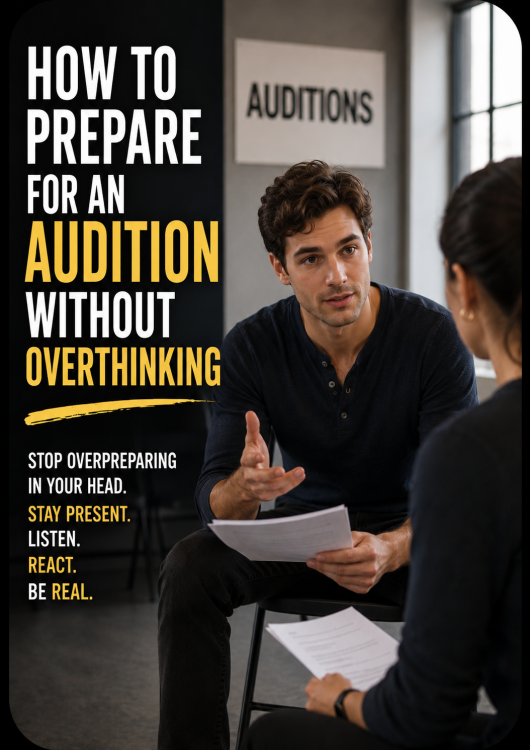
If I ever wrote a book about acting, it would only be three words long.
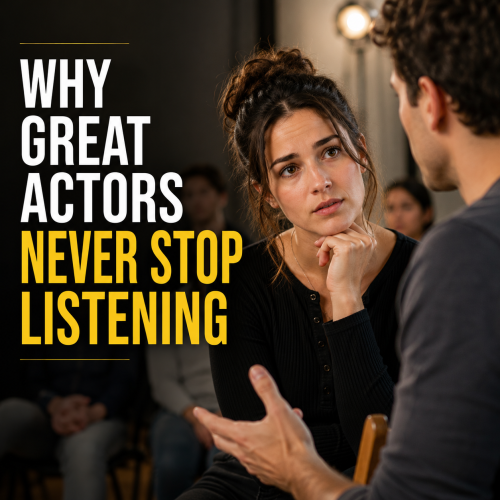
Listen and React.
Those three words are at the core of everything I teach in my online acting studio, and they are the reason so many actors struggle in auditions without knowing why.
I’m Richard Kline, a working actor and acting coach, and I’ve spent decades on camera, on stage, and now coaching actors through live online acting classes.
I can tell you this with certainty: most actors are not failing because they lack talent. They are failing because they are not truly listening.
In real life, you do not “act.”
You simply are.
You naturally inhabit your environment. You speak differently to your boss than you do to a cranky neighbor. You listen and respond differently to your spouse than to someone you are trying to impress. Your tone, your rhythm, your energy all shift without you thinking about it.
That is what organic behavior looks like.
In acting, we take that same organic listening and run it through the filter of the character we are playing.
You listen as that character. You react as that character. And suddenly, what you are doing feels real.
Not performed. Not recited. Real.
When casting directors watch an audition or a self-tape, they are not looking for someone to “say the lines well.”
They are looking for someone who is actually hearing the other person.
They want to see:
If your performance is disconnected from what you are hearing, the scene becomes flat. Even if the emotion is there, it feels artificial.
That is why so many talented actors keep auditioning but don’t book.
Real acting happens beneath the lines.
It happens in what you are thinking, feeling, and responding to as the other person speaks.
When you are truly listening, your reactions change moment by moment. Your eyes change. Your timing changes. Your energy changes. You are no longer “delivering dialogue.” You are having a human experience.
This is what casting directors trust.
This is what makes you watchable.
Today, most auditions happen on camera through self-tapes.
The camera sees everything.
If you are not listening, the camera knows.
In my live online acting classes, we train specifically for this. We work on how to listen on camera, how to respond truthfully in close-ups, and how small, honest reactions create powerful performances.
Actors are often shocked by how much more compelling they become once they stop “acting” and start listening.
Here is something I tell my students to do.
Pay attention to how you listen and speak throughout your day.
Notice how your tone changes with different people. Notice how your body shifts. Notice how what you hear affects what you say next.
As Shakespeare said, “All the world’s a stage.”
This awareness is the foundation of great acting.
In my online acting studio, we do not train actors to perform. We train actors to listen, react, and work the way casting actually works.
That means:
When actors understand how to listen and respond truthfully, their auditions change. And when their auditions change, their booking rate changes.
If you have been auditioning but not booking, I offer a free audit of your work. I will tell you exactly what is coming across on camera and what to adjust so you can become more competitive.
Request Your Free Acting Audit
Training smarter, not harder, is how actors start booking.